Buy baleares.info ?
We are moving the project
baleares.info .
Are you interested in purchasing the domain
baleares.info ?
domain@kv-gmbh.de · 0541-91531010
Buy baleares.info ?
What is the degree of homogeneity?
The degree of homogeneity refers to the level of uniformity or similarity within a group or population. It measures the extent to which the individuals or elements within the group are alike in terms of certain characteristics or attributes. A high degree of homogeneity indicates a high level of similarity, while a low degree of homogeneity indicates a greater diversity or variation within the group. This concept is often used in statistics, sociology, and other fields to analyze and understand the composition and characteristics of a given group. **
Was the degree of homogeneity correctly calculated?
Yes, the degree of homogeneity was correctly calculated. The formula used to calculate homogeneity takes into account the number of categories and the distribution of values within those categories, providing an accurate measure of how similar or different the data points are. By applying this formula to the dataset, the degree of homogeneity was determined accurately. **


Similar search terms for Homogeneity
Top-Angebote
Products related to Homogeneity:
-
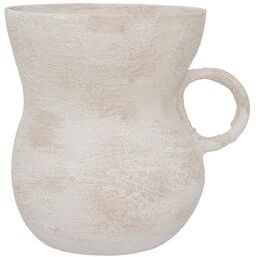
Urban Nature Culture Vase RelaxedQuiet elegancy comes to life in Urban Nature Culture's vase Relaxed. Handmade in Portugal, this ceramic vase has a shape beyond anything you've seen - it's organic, it flows and steals your heart with its playful ear.123,40 $*Shipping: 0,00 $Secure redirect to the provider
-
Urban Nature Culture Vase Ace - AceSetting forth a tradition that is centuries old, pottery has ever been one of Portugal's trades. Urban Nature Culture loves to work with Portuguese artisans - who use their skills to combine modern looks and contemporary design with techniques of old.145,60 $*Shipping: 0,00 $Secure redirect to the provider



-
Was the degree of homogeneity calculated correctly?
Yes, the degree of homogeneity was calculated correctly. The formula used to calculate homogeneity takes into account the differences between the observed frequencies and the expected frequencies under the null hypothesis. By comparing these values and calculating the chi-square statistic, we can determine the degree of homogeneity in the data. **
-
How can one check for homogeneity in mathematics?
One can check for homogeneity in mathematics by examining whether a mathematical expression or equation remains unchanged when all its variables are scaled by a common factor. For example, in an equation like ax + by = c, if we multiply both sides of the equation by a constant k, the equation remains unchanged if a and b are both multiplied by k. This property is known as homogeneity. Another way to check for homogeneity is to verify that the dimensions of all terms in an equation are consistent, meaning that they have the same units. If an equation is homogeneous, it means that it is invariant under scaling, which can be a useful property in mathematical analysis and modeling. **
-
Is the Levene test for homogeneity of variances the same as one-way ANOVA?
No, the Levene test for homogeneity of variances is a separate statistical test used to assess whether the variances of the groups being compared in an ANOVA are equal. On the other hand, one-way ANOVA is a hypothesis test used to determine whether there are statistically significant differences between the means of three or more independent groups. The Levene test is often conducted before performing an ANOVA to ensure that the assumption of homogeneity of variances is met. **
-
Is the Levene test for homogeneity of variances the same as the one-way ANOVA?
No, the Levene test for homogeneity of variances is a separate statistical test from the one-way ANOVA. The Levene test is used to determine if the variances of the groups being compared in an ANOVA are equal. It tests the null hypothesis that the variances are equal across all groups. On the other hand, the one-way ANOVA is used to test the null hypothesis that the means of the groups are equal. While both tests are related to comparing groups, they are testing different aspects of the data. **


Which islands have hardly any binge-drinking tourism?
Islands such as Bora Bora, Seychelles, and the Maldives have hardly any binge-drinking tourism. These destinations are known for their luxury resorts, pristine beaches, and focus on relaxation and wellness rather than partying and excessive drinking. Visitors to these islands typically come to unwind, enjoy the natural beauty, and indulge in activities such as spa treatments, water sports, and romantic dinners. Overall, these islands offer a more tranquil and upscale experience, attracting travelers seeking a peaceful and rejuvenating vacation. **
Which islands have little to no binge-drinking tourism?
Islands such as Bora Bora, Seychelles, and Maldives have little to no binge-drinking tourism. These islands are known for their luxury resorts, pristine beaches, and focus on relaxation and wellness rather than partying. Visitors to these destinations are more likely to indulge in spa treatments, water sports, and cultural experiences rather than excessive drinking. The tranquil and serene atmosphere of these islands attracts a more upscale and discerning clientele seeking a peaceful and rejuvenating vacation. **
Top-Angebote
Products related to Homogeneity:
-
Urban Nature Culture Vase RelaxedQuiet elegancy comes to life in Urban Nature Culture's vase Relaxed. Handmade in Portugal, this ceramic vase has a shape beyond anything you've seen - it's organic, it flows and steals your heart with its playful ear.123,40 $*Shipping: 0,00 $Secure redirect to the provider
-
What is the degree of homogeneity?
The degree of homogeneity refers to the level of uniformity or similarity within a group or population. It measures the extent to which the individuals or elements within the group are alike in terms of certain characteristics or attributes. A high degree of homogeneity indicates a high level of similarity, while a low degree of homogeneity indicates a greater diversity or variation within the group. This concept is often used in statistics, sociology, and other fields to analyze and understand the composition and characteristics of a given group. **
-
Was the degree of homogeneity correctly calculated?
Yes, the degree of homogeneity was correctly calculated. The formula used to calculate homogeneity takes into account the number of categories and the distribution of values within those categories, providing an accurate measure of how similar or different the data points are. By applying this formula to the dataset, the degree of homogeneity was determined accurately. **
-
Was the degree of homogeneity calculated correctly?
Yes, the degree of homogeneity was calculated correctly. The formula used to calculate homogeneity takes into account the differences between the observed frequencies and the expected frequencies under the null hypothesis. By comparing these values and calculating the chi-square statistic, we can determine the degree of homogeneity in the data. **
-
How can one check for homogeneity in mathematics?
One can check for homogeneity in mathematics by examining whether a mathematical expression or equation remains unchanged when all its variables are scaled by a common factor. For example, in an equation like ax + by = c, if we multiply both sides of the equation by a constant k, the equation remains unchanged if a and b are both multiplied by k. This property is known as homogeneity. Another way to check for homogeneity is to verify that the dimensions of all terms in an equation are consistent, meaning that they have the same units. If an equation is homogeneous, it means that it is invariant under scaling, which can be a useful property in mathematical analysis and modeling. **
Similar search terms for Homogeneity
-
Urban Nature Culture Vase Ace - AceSetting forth a tradition that is centuries old, pottery has ever been one of Portugal's trades. Urban Nature Culture loves to work with Portuguese artisans - who use their skills to combine modern looks and contemporary design with techniques of old.145,60 $*Shipping: 0,00 $Secure redirect to the provider
-
Urban Nature Culture Vase Talvi - WhiteFloating the sea waves, a sense of calm takes over, feeling at home in the world. That same feeling we get at home, like a safe haven to relax our senses and feast our eyes on our most cherished things.267,80 $*Shipping: 0,00 $Secure redirect to the provider
-
Is the Levene test for homogeneity of variances the same as one-way ANOVA?
No, the Levene test for homogeneity of variances is a separate statistical test used to assess whether the variances of the groups being compared in an ANOVA are equal. On the other hand, one-way ANOVA is a hypothesis test used to determine whether there are statistically significant differences between the means of three or more independent groups. The Levene test is often conducted before performing an ANOVA to ensure that the assumption of homogeneity of variances is met. **
-
Is the Levene test for homogeneity of variances the same as the one-way ANOVA?
No, the Levene test for homogeneity of variances is a separate statistical test from the one-way ANOVA. The Levene test is used to determine if the variances of the groups being compared in an ANOVA are equal. It tests the null hypothesis that the variances are equal across all groups. On the other hand, the one-way ANOVA is used to test the null hypothesis that the means of the groups are equal. While both tests are related to comparing groups, they are testing different aspects of the data. **
-
Which islands have hardly any binge-drinking tourism?
Islands such as Bora Bora, Seychelles, and the Maldives have hardly any binge-drinking tourism. These destinations are known for their luxury resorts, pristine beaches, and focus on relaxation and wellness rather than partying and excessive drinking. Visitors to these islands typically come to unwind, enjoy the natural beauty, and indulge in activities such as spa treatments, water sports, and romantic dinners. Overall, these islands offer a more tranquil and upscale experience, attracting travelers seeking a peaceful and rejuvenating vacation. **
-
Which islands have little to no binge-drinking tourism?
Islands such as Bora Bora, Seychelles, and Maldives have little to no binge-drinking tourism. These islands are known for their luxury resorts, pristine beaches, and focus on relaxation and wellness rather than partying. Visitors to these destinations are more likely to indulge in spa treatments, water sports, and cultural experiences rather than excessive drinking. The tranquil and serene atmosphere of these islands attracts a more upscale and discerning clientele seeking a peaceful and rejuvenating vacation. **
* All prices are inclusive of VAT and, if applicable, plus shipping costs. The offer information is based on the details provided by the respective shop and is updated through automated processes. Real-time updates do not occur, so deviations can occur in individual cases. ** Note: Parts of this content were created by AI.